Condensation on bedroom windows, a lingering damp smell and mould returning after every clean are often signs that a home is holding onto too much moisture. This guide to energy recovery ventilation explains how an ERV system can replace stale indoor air without throwing away the heating or cooling you have paid for – and where it fits within a healthy-home solution.
What energy recovery ventilation does
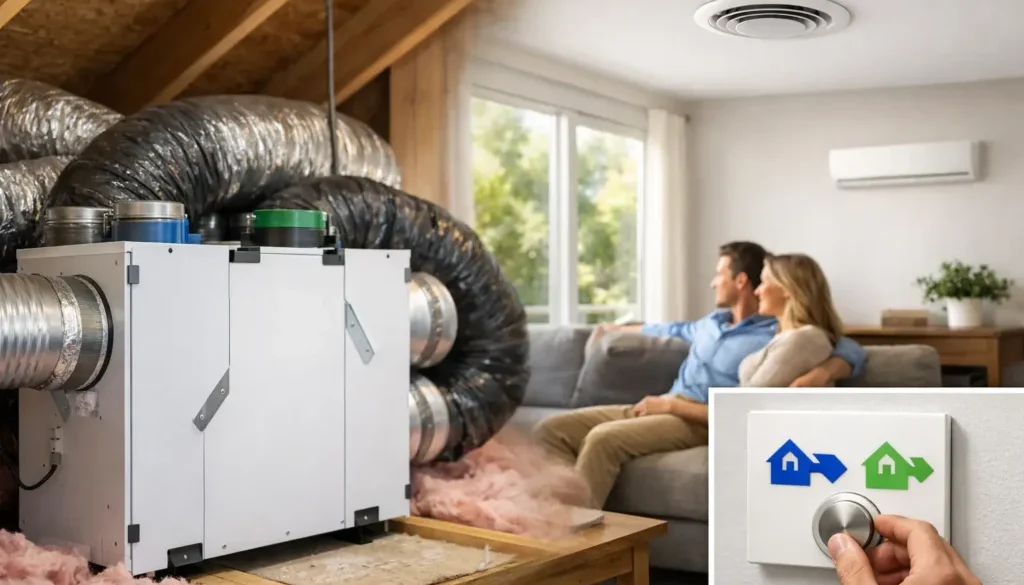
Energy recovery ventilation, usually shortened to ERV, is balanced mechanical ventilation. The system continuously removes stale air from moisture and pollutant-heavy areas such as bathrooms, laundries and kitchens, while bringing filtered outdoor air into living areas and bedrooms.
Its defining feature is the heat exchanger. As outgoing and incoming air pass through separate channels inside the unit, energy transfers between them. In winter, warmth from the extracted indoor air pre-warms the incoming fresh air. In summer, the cooler indoor air can temper the incoming outdoor air. The two air streams do not mix.
An ERV also transfers a controlled amount of moisture vapour through its exchanger. That is the practical difference between energy recovery ventilation and many heat recovery ventilation, or HRV, systems. An HRV primarily recovers heat, while an ERV recovers both heat and some moisture. This can help homes maintain more stable indoor humidity through changing seasons.
The result is not a home sealed away from fresh air. It is a home with planned, measured air exchange: cleaner air coming in, damp and stale air going out, and less energy lost in the process.
Why Melbourne homes can benefit
Melbourne’s weather can shift sharply across a day, and homes are increasingly built or renovated to be more airtight. Better sealing is useful for energy efficiency, but it also means moisture from showers, cooking, drying clothes and simply breathing has fewer paths out.
In older houses, draughts may provide accidental ventilation, but they do not necessarily remove moisture from the rooms where it is created. They can also make rooms cold and uncomfortable. In newer homes, insulation and tighter construction can expose ventilation weaknesses if there is no deliberate way to exhaust humid air and supply fresh replacement air.
For families managing allergies or asthma, the benefit is broader than reducing window condensation. Consistent filtered ventilation can dilute indoor contaminants from cooking, cleaning products, furnishings and everyday occupancy. Filtration will not remove every indoor pollutant, and an ERV is not a substitute for a properly ducted kitchen rangehood, but it can make the overall indoor environment fresher and more predictable.
A guide to energy recovery ventilation: when it is the right choice
ERV is often a strong option for a well-sealed new build, a major renovation or an existing home where occupants want whole-home fresh air with low running costs. It is particularly suited to households that notice stale bedrooms overnight, recurring condensation in winter, or humidity that remains high after showers and cooking.
However, ventilation should not be treated as a cure for every moisture problem. If rainwater is entering through a roof, wall or failed flashing, that building defect needs repair. If the subfloor is wet due to poor drainage, plumbing leaks or ground moisture, the subfloor needs its own assessment and solution. An ERV improves air exchange above the floor, but it cannot dry structural materials affected by an active water source.
The right approach starts by identifying where moisture is coming from, how the home is constructed, how airtight it is, and which rooms are affected. This is why a home-specific design matters more than selecting a unit based on floor area alone.
ERV, HRV and positive pressure systems compared
The terms can sound similar, but the systems operate differently.
An ERV is balanced ventilation with energy and moisture transfer. It supplies and extracts air through dedicated pathways, making it well suited to homes seeking controlled whole-home ventilation and year-round energy efficiency.
An HRV is also generally balanced ventilation, but its heat exchanger is designed mainly to recover sensible heat rather than moisture. It can be an excellent solution in the right home, especially where heat recovery is the central priority. Whether HRV or ERV is preferable depends on local climate, household moisture loads, occupancy and the desired humidity outcome.
A positive pressure system usually introduces filtered air, commonly into a central area, to create gentle pressure that encourages indoor air to leave through gaps and purpose-made openings. It can improve freshness in some existing homes and may be simpler to install, but it does not provide the same balanced extraction or energy recovery as an ERV.
Decentralised ERV units are another option. Rather than one central unit with ductwork, smaller wall-mounted units serve individual rooms or paired spaces. They can be valuable in targeted renovations, apartments or homes where installing ducts is impractical. A centralised system can offer more complete room-by-room control, while decentralised ventilation may reduce installation disruption. Neither is automatically better.
What a well-designed system looks like
A good ERV design is quiet enough to run consistently and matched to the way your household uses the home. Running a ventilation system briefly at high speed is rarely as effective as providing steady, low-level air change every day, with boost capacity for showers, cooking or larger gatherings.
Fresh air is commonly supplied to bedrooms and living spaces. Stale air is extracted from bathrooms, laundries and other wet areas. Air then travels through the home via door undercuts, transfer grilles or carefully planned pathways. Without this movement between supply and extract zones, even a premium unit cannot perform as intended.
System sizing should consider more than bedroom numbers. Ceiling heights, occupancy, room layout, building airtightness, bathroom use, internal clothes drying and the presence of gas appliances can all affect the ventilation requirement. Duct routes, roof-space access and acoustic treatment also influence the final design.
Noise deserves attention early. Fans, duct velocity, grille location and vibration isolation all affect what occupants hear. A system that is technically capable but too noisy may be switched off, defeating its purpose.
Installation and commissioning matter
ERV performance relies on correct installation, not just product quality. Ducts need to be appropriately sized and insulated where required. Outdoor intake and exhaust points need careful placement so the system draws in clean air and avoids reintroducing exhausted air, smoke or other contaminants.
After installation, the system should be commissioned. This means checking airflow at relevant grilles, balancing supply and extraction, confirming controls operate properly and showing the homeowner how to use the system. A poorly balanced system can create drafts, uneven ventilation or disappointing moisture control.
For Melbourne and Victorian homes, local experience is useful because roof spaces, weatherboard construction, brick veneers, apartments and renovation constraints all call for different installation methods. Ecoflow Ventilation assesses the home before recommending whether centralised, decentralised or another ventilation approach is appropriate.
How to run and maintain an ERV
Most ERV systems are designed to run continuously at a low background setting. Turning the system off whenever the house feels comfortable can allow humidity and pollutants to build up again, particularly overnight or during wet weather. Use boost mode during and after showers, while cooking, or when drying laundry indoors.
Filters need regular checking and replacement or cleaning according to the manufacturer’s instructions and local conditions. A home near a busy road, construction site or bushfire-prone area may need more frequent attention than one in a cleaner setting. Blocked filters reduce airflow and can increase fan energy use.
The external grilles should be kept clear of leaves, dust and cobwebs. Periodic professional servicing can check fans, condensate management where applicable, duct condition and airflow balance. This helps protect both comfort and the system’s long-term efficiency.
Questions homeowners often ask
Will an ERV stop mould?
It can reduce one of mould’s key conditions: persistent indoor humidity and condensation. But mould also needs to be cleaned safely, and any leaks, rising damp, subfloor moisture or inadequate bathroom waterproofing must be addressed. Think of ERV as part of moisture control, not a standalone repair for every mould problem.
Does an ERV replace opening windows?
No. You can still open windows whenever you want outdoor air. The advantage of ERV is that it provides consistent filtered ventilation when windows are closed, when it is cold or hot outside, when the home is unattended, or when outdoor noise and security make open windows less practical.
Does it use much electricity?
ERV fans use electricity, so there is always a running cost. The trade-off is that recovered energy reduces the heating and cooling load associated with bringing in fresh outdoor air. Actual results depend on the unit, airflow settings, climate, household habits and how efficiently the rest of the home is heated or cooled.
A healthier home is not created by a single appliance. It comes from understanding moisture sources, improving airflow and choosing a ventilation system that suits the building and the people living in it. For homes where stale air and condensation have become normal, a properly designed ERV can make fresh, comfortable indoor air feel normal instead.