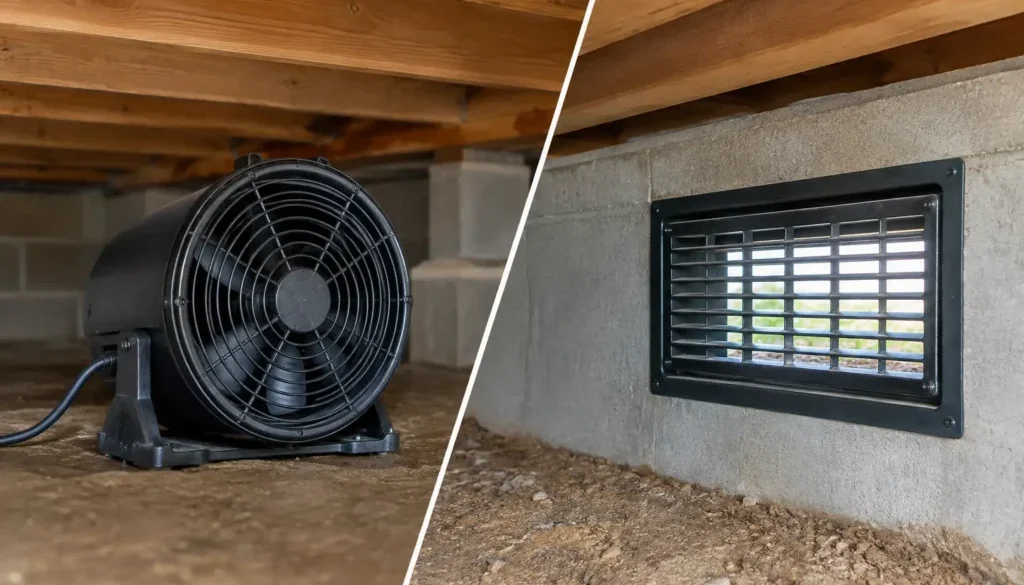
A musty smell when you open a cupboard, cold timber floors in winter, or mould that returns after cleaning can all point below the house. When weighing up subfloor fans versus vents, the real question is not which product is better in every home. It is whether your subfloor receives enough reliable airflow to dry out moisture before it affects your floors, framing and indoor air.
For many Victorian homes, particularly older properties with enclosed crawl spaces, passive vents are a starting point rather than a complete solution. A properly designed mechanical system can provide far more dependable air movement, but only when it addresses the actual moisture conditions under the home.
Subfloor Fans Versus Vents: The Key Difference
Passive subfloor vents are fixed openings in the perimeter walls or brickwork. They allow outside air to enter and leave the underfloor area through natural air movement. Wind, changes in outdoor air pressure and differences in temperature all influence how well they work.
Subfloor fans use electricity to move air deliberately. Depending on the design, fans may extract damp air from the subfloor, introduce drier outside air, or create a planned path of air from one side of the space to the other. This mechanical assistance makes airflow less dependent on a still day, poor site orientation or obstructed vent openings.
Neither approach removes water. They manage moisture by helping damp air leave and allowing conditions beneath the floor to dry. If a plumbing leak, poor drainage, groundwater entry or inadequate site grading is continually adding water under the house, that issue needs attention first. Ventilation cannot compensate for standing water or saturated soil.
When Passive Vents Can Be Enough
Vents can work well in a subfloor that is naturally dry, open around multiple sides and exposed to regular breezes. They are quiet, have no running cost and require little ongoing attention beyond keeping openings clear. In a newer home with good drainage, sufficient clearance and genuine cross-ventilation, additional fans may not be necessary.
The limitation is consistency. A vent is only effective when there is a pressure difference to drive air through it. If the home is close to neighbouring buildings, has landscaping against the perimeter, sits on a sheltered block, or has enclosed sections under extensions, airflow may be weak or uneven. One side of the subfloor can remain stale while another is reasonably dry.
Blocked or covered vents are also common. Garden beds, soil build-up, stored materials, decks and renovation work can restrict openings that were originally intended to ventilate the space. Simply adding more vents is not always the answer if their location does not establish a clear route for air to travel.
Why Subfloor Fans Often Deliver Better Moisture Control
A fan system is useful where natural ventilation is unreliable. It creates predictable air exchange and can be designed around the layout of the house rather than relying on whatever breeze happens to reach a vent.
This matters in Melbourne’s cooler, wetter months, when underfloor areas can remain damp for long periods. Moist timber and stagnant air create conditions that support fungal growth and can contribute to the musty odour homeowners notice inside. Prolonged dampness may also affect timber floorboards, joists and bearers, increasing the risk of movement, decay and costly repairs.
Well-positioned fans can draw air through hard-to-reach sections of an irregular subfloor. This is particularly valuable in homes with additions, internal brick walls, low-clearance areas or separate underfloor compartments. The aim is not to put the biggest fan into the easiest opening. It is to create a balanced airflow path that reaches the dampest areas.
Fans do have trade-offs. They use power, make some operational noise and need professional selection and installation. The system should be appropriate for the size and volume of the subfloor, the number and placement of existing vents, and the resistance created by ducts, grilles and tight access areas. An undersized or poorly positioned fan may run without meaningfully improving conditions.
Humidity Matters More Than Air Movement Alone
More airflow is usually helpful in a damp subfloor, but outdoor air is not always dry air. On a humid or rainy day, bringing large volumes of moist outside air into a cool underfloor area may not produce the drying result expected. This is why a proper assessment considers relative humidity, temperature, drainage and the source of moisture, not just the presence of vents.
In many cases, extracting stale, damp air is the preferred approach. In others, a combination of intake and exhaust points is needed to avoid dead zones. The right configuration depends on the home’s construction and local conditions.
A moisture assessment may identify problems that ventilation alone cannot resolve, including leaking pipes, failed drainage, surface water flowing towards the house, inadequate stormwater management, damaged downpipes or poor ground clearance. Addressing these issues protects the ventilation investment and gives the subfloor a real chance to dry.
Avoid creating a shortcut for air
Air follows the easiest available path. If a fan is installed near a large existing vent, it may pull air from that nearby opening while leaving distant sections largely untouched. Effective designs account for the entire subfloor layout, using vent locations, ducting or additional airflow points where needed.
This is also why an inspection is valuable before purchasing an off-the-shelf fan. Two homes with the same floor area can have very different underfloor volumes, access constraints and moisture loads.
Signs Your Home May Need Mechanical Subfloor Ventilation
A persistent musty odour indoors is a common warning sign, especially if it is stronger after rain or during winter. Other indicators include visible mould on floor framing, damp soil that does not dry, condensation on pipes, cold or cupping timber floors, and vents that are present but provide little apparent airflow.
You may also need closer assessment if you have allergies or asthma and notice symptoms worsening at home. Air from a damp subfloor can enter the living areas through gaps around pipe penetrations, flooring and wall cavities. While subfloor ventilation is not a substitute for managing all indoor air quality issues, reducing underfloor dampness can remove one significant source of stale, mould-prone air.
Do not assume that a damp subfloor means the house needs fans immediately. Some homes first need drainage repairs, clearance around vents or the removal of debris. Others need a combination of repairs and mechanical ventilation for a lasting outcome.
Choosing Between Fans, Vents or Both
The most effective answer is often both. Existing passive vents can provide useful make-up air while strategically located fans establish the airflow needed to exhaust moisture. This can be an efficient option when the vents are in good condition but natural cross-ventilation is too inconsistent.
A vents-only approach may suit a dry, open and well-drained subfloor with clear openings around the perimeter. Mechanical fans are more likely to be worthwhile where the home is sheltered, the subfloor is compartmentalised, dampness is recurring or the property has a history of mould and musty odours.
Before deciding, assess the moisture source, inspect all accessible areas beneath the home, check the condition and placement of vents, and consider whether airflow can reach every section. A system should be designed for the house you have, not a standard layout on a box.
For homeowners across Melbourne and Victoria, this tailored approach is particularly useful because housing styles, block conditions and winter moisture levels vary widely. Ecoflow Ventilation assesses how air, humidity and building conditions interact before recommending a subfloor ventilation solution.
A dry, well-ventilated subfloor supports more than the structure above it. It helps create a home that smells fresher, feels more comfortable underfoot and is less hospitable to mould. The best next step is to identify why moisture is lingering, then choose ventilation that gives it a reliable path out.