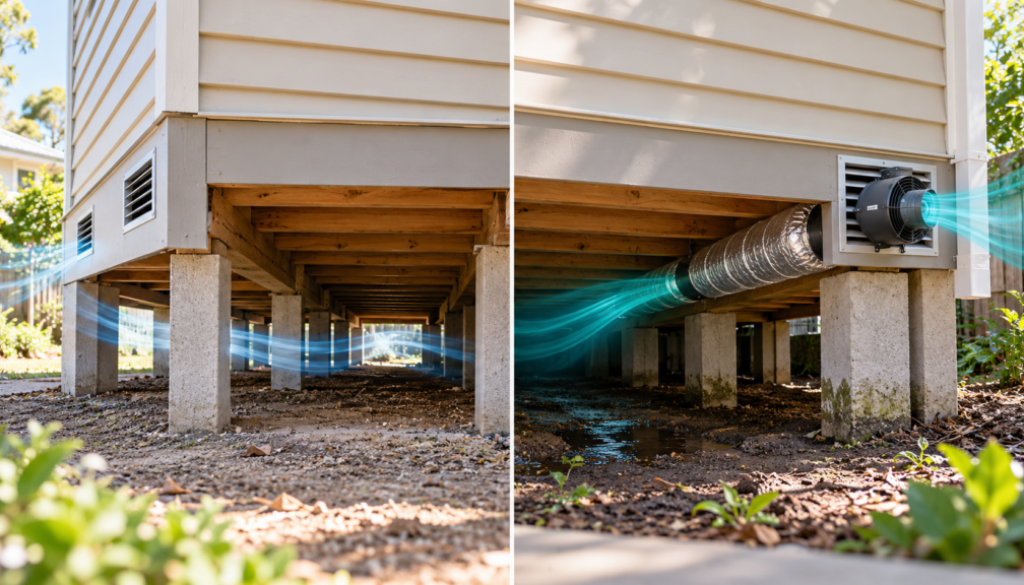
Passive vs Mechanical Subfloor Ventilation Melbourne
Not every damp subfloor needs a fan. In some Melbourne homes, clearing or improving the existing vents may provide enough airflow. In others, the layout beneath the house prevents natural air movement from reaching the damp areas.
The choice between passive and mechanical subfloor ventilation depends on where moisture is coming from and how air can move beneath the floor.
What is passive subfloor ventilation?
Passive ventilation uses openings around the outside of a building to let air move naturally beneath a suspended floor. It does not use powered fans.
It may work well when vents are clear and appropriately positioned, the subfloor is reasonably open, and air can travel between openings on different sides of the house. Ground moisture also needs to be managed.
Passive ventilation is simple: there are no fans to power and little mechanical equipment to maintain.
When can passive ventilation struggle?
Natural airflow depends on the building and outdoor conditions. It can be restricted when:
- Soil, garden beds or stored items block vents
- Internal foundation walls divide the subfloor
- An extension has covered vents or created an isolated area
- The centre of the house is far from external openings
- The site is sheltered from wind
- Damp soil adds more moisture than the available airflow can remove
Adding a vent around the perimeter may help, but it will have limited effect if air still cannot reach the problem area.
What is mechanical subfloor ventilation?
Mechanical ventilation uses fans to move air through the subfloor. A system may extract damp air, supply outdoor air, or use both methods. Ductwork can extend airflow to sections that perimeter vents do not reach.
Fans may be operated with timers or environmental controls, depending on the conditions beneath the home. The main benefit is the ability to plan an airflow path rather than relying entirely on natural air movement.
When might fans be needed?
Mechanical ventilation may be worth considering when existing vents are clear but the subfloor remains damp or musty, natural cross-flow is limited, or internal walls and renovations have left areas isolated.
It may also help when an extraction point needs to be placed deeper beneath the house. The number and position of fans should follow the airflow path required for that property.
Before installing fans, the source of the moisture should be checked. A ventilation system cannot repair leaking plumbing, faulty drainage or stormwater flowing beneath the house.
What about negative pressure extraction?
For many damp subfloors, Ecoflow Ventilation considers an extraction system. Fans remove air from beneath the house and discharge it outdoors, while replacement air enters through selected vents.
This approach allows the inlet and extraction points to be positioned so air travels through the affected sections. Some layouts may instead suit supply ventilation or a combination of supply and extraction.
Which option is better for your home?
Passive ventilation may be sufficient when clear vents provide effective airflow through the whole subfloor. Mechanical ventilation can be useful when the layout or moisture conditions call for more control.
The practical question is whether air currently reaches the areas that need to dry. An assessment should look at the vents, internal walls, ground conditions, damp areas and any signs of water entering beneath the house.
Get your subfloor airflow assessed
Ecoflow Ventilation assesses Melbourne homes before recommending equipment. The right response may be to improve passive airflow, install a mechanical system, repair a moisture source, or combine these measures.
Contact Ecoflow Ventilation to discuss which approach suits your subfloor.