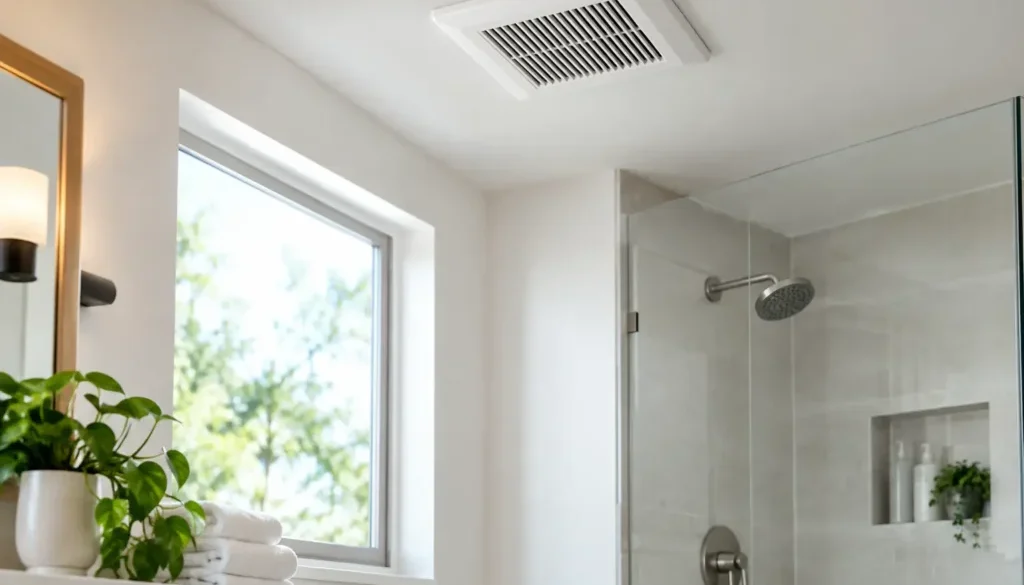
A bathroom can look clean and still hold a surprising amount of moisture. One long shower can leave steam on mirrors, water droplets on windows and humid air settling into ceilings, grout, plaster and adjoining rooms. This guide to bathroom ventilation explains how to remove that moisture properly, reduce the conditions mould needs to grow, and choose a solution that suits your home rather than simply making more noise.
Why bathroom ventilation matters
Bathrooms produce high levels of moisture in a short period. If that moist air is not exhausted outdoors, it condenses on cooler surfaces. In Melbourne homes, this is often most noticeable through winter, when cold windows, external walls and roof spaces create ideal condensation points.
Over time, poor ventilation can contribute to peeling paint, swollen cabinetry, deteriorating silicone, persistent musty smells and mould on ceilings or around windows. It can also allow humidity to move beyond the bathroom, particularly in homes with open internal layouts, gaps under doors or poor whole-home airflow.
Cleaning visible mould is worthwhile, but it does not address the cause. If a bathroom stays damp after every shower, mould commonly returns because the moisture source remains. Effective ventilation is about removing humid air quickly and consistently, not masking odours or relying on an open window alone.
A guide to bathroom ventilation: the essentials
A well-ventilated bathroom needs three things: effective extraction, a clear path for replacement air to enter, and controls that keep the system running long enough after bathing. Miss one of these elements and even a powerful fan can underperform.
Extract humid air to the outside
The most important rule is simple: bathroom exhaust air should be discharged outdoors. A fan that releases moist air into the roof cavity may make the bathroom feel better temporarily, but it relocates the problem. Moisture in a roof space can contribute to condensation, damp insulation, timber deterioration and mould growth.
Ducting should be appropriately sized, as short and straight as practical, and installed to limit air leakage and sagging. Long duct runs, sharp bends and undersized flexible ducting all reduce airflow. A fan is only as effective as the path the air takes after it enters the grille.
Where discharge locations are planned, they also need to avoid sending humid air back towards openable windows, doors or other intake points. This is one reason professional design matters, particularly in renovations or tightly built homes.
Give replacement air somewhere to come from
An exhaust fan cannot remove air efficiently if the bathroom is sealed tight. As air leaves the room, replacement air needs a route in, usually through the gap beneath the door or a purpose-designed transfer path.
A bathroom door with no undercut can cause a fan to strain against negative pressure, reducing the air it actually extracts. You may notice the door becoming harder to open or the fan sounding louder without clearing steam effectively. The answer is not always a bigger fan. Sometimes a modest door undercut or transfer grille makes a meaningful difference.
Run the fan after the shower finishes
Turning a fan off the moment you step out leaves the most humid air behind. A run-on timer allows extraction to continue while surfaces dry, which is often more effective than running a fan only during the shower.
Humidity sensors can also be useful. They switch the fan on when moisture rises and keep it operating until humidity falls. However, sensor settings need to suit the room and household. A poorly calibrated sensor may stop too soon or run unnecessarily during naturally humid weather.
For many homes, a quiet fan with a timer is a reliable, easy-to-use option. The best control method depends on how the bathroom is used, how much natural ventilation it has and whether moisture problems occur elsewhere in the house.
How much airflow does your bathroom need?
Fan capacity is commonly described in litres per second or cubic metres per hour. Higher numbers can mean more extraction, but capacity on the box is not the same as performance once ducting is installed.
The required airflow depends on the bathroom’s size, ceiling height, shower use, duct length and number of bends. An ensuite used by one person each morning has different demands from a family bathroom used repeatedly across the day. A bathroom with a bath, shower and limited access to external windows may need more considered extraction than a small powder room.
Noise matters too. Homeowners often avoid using loud fans, especially early in the morning or late at night. A quieter, correctly specified system that people leave running is generally more useful than an oversized fan that is switched off quickly. Look at both airflow and sound level, then consider the installed duct design rather than selecting on fan power alone.
Is an open window enough?
An open window can help, particularly on mild, dry days when there is a breeze. But it is not dependable as the only moisture-control strategy. During cold, wet or still weather, opening a window may provide little practical extraction and can make the room uncomfortable.
Windows also rely on occupant behaviour. They may remain shut for privacy, security, noise or heating reasons. In many Melbourne bathrooms, an open window in winter can introduce cold air while humid air still lingers around the ceiling and shower area.
Natural ventilation works best as a supplement to mechanical extraction, not a replacement for it. If condensation regularly forms despite opening the window, the bathroom needs more consistent airflow.
Common signs your bathroom ventilation is not working
The warning signs are often visible before serious damage develops. Pay attention if the mirror stays fogged for a long time after showering, water runs down windows, paint bubbles on the ceiling, or mould repeatedly appears on grout, silicone and cornices.
A damp or stale smell is another clue, especially if it returns soon after cleaning. You may also find that towels take too long to dry, cabinetry feels swollen, or the bathroom door and surrounding hallway feel humid after use.
Not every moisture issue starts in the bathroom. Condensation across several rooms, mould in wardrobes or a persistent musty smell under the house can point to broader ventilation, insulation, drainage or subfloor concerns. A bathroom fan may be necessary, but it may not be the complete solution.
Choosing between a standard fan and a designed ventilation solution
For a straightforward bathroom with an accessible ceiling space and a direct external discharge route, a quality exhaust fan with suitable ducting, backdraft protection and a timer may be all that is needed. This approach can be effective and economical when the source of moisture is localised.
Renovations, apartments, airtight new homes and older houses with repeated condensation may need a more considered design. Decentralised ventilation units can provide controlled extraction and fresh-air supply in selected areas. Centralised mechanical ventilation can serve multiple wet rooms, while heat or energy recovery systems may be appropriate where controlled fresh air and energy efficiency are priorities.
These systems are not interchangeable. Heat recovery ventilation, for example, is designed to exchange stale indoor air for filtered fresh air while recovering heat from outgoing air. It is not simply a stronger bathroom fan. The right choice depends on the home’s layout, building fabric, existing ventilation paths and the pattern of moisture problems.
Installation details that make a real difference
Position the extract point where steam collects, usually near the shower or bath but in accordance with electrical safety requirements. A fan placed too far from the moisture source may leave humid air circulating through the room before it is captured.
Duct insulation can be valuable where warm, moist air travels through a cold roof space. Without it, condensation may form inside the duct and reduce the system’s effectiveness. Exterior grilles should also be selected and located to resist weather entry while allowing air to discharge freely.
Electrical work must be completed by a licensed electrician, and installation should account for relevant Australian requirements and manufacturer instructions. This is particularly important in bathrooms, where electrical zones, clearances and wet-area safety apply.
Simple habits that support better ventilation
Ventilation systems work best alongside sensible daily habits. Run the fan during showers and afterwards, keep the bathroom door closed while showering so moisture is extracted at the source, and avoid drying large loads of washing in the bathroom where possible.
Wipe down heavy water pooling on shower screens and windows if condensation is severe, but treat this as a short-term aid rather than the solution. Also check that external grilles are clear of leaves, dust and insect build-up, and have fans serviced or assessed if airflow has noticeably reduced.
A dry, comfortable bathroom should not depend on remembering to crack a window or scrub mould every few weeks. When ventilation is designed around the way your household uses the home, it protects finishes, supports healthier indoor air and makes everyday living feel noticeably more comfortable. For recurring moisture or condensation concerns, a home-specific assessment from Ecoflow Ventilation can identify whether the answer is a better bathroom fan, improved ducting or a broader ventilation strategy.