A bathroom can look spotless and still be one of the dampest rooms in the house. Steam from a shower settles on mirrors, walls, windows and ceilings, then seeps into paint, plasterboard, grout and cabinetry. Choosing the best ventilation for bathrooms is less about buying the loudest exhaust fan and more about removing moist air reliably, for long enough, and without wasting unnecessary energy.
For Melbourne homes, this matters through every season. Cold mornings make condensation more visible, while tightly sealed homes can hold onto humidity and stale air year-round. If mould returns after cleaning, paint is peeling above the shower, or windows regularly sweat, the ventilation approach may be undersized, poorly ducted or simply not suited to the home.
What is the best ventilation for bathrooms?
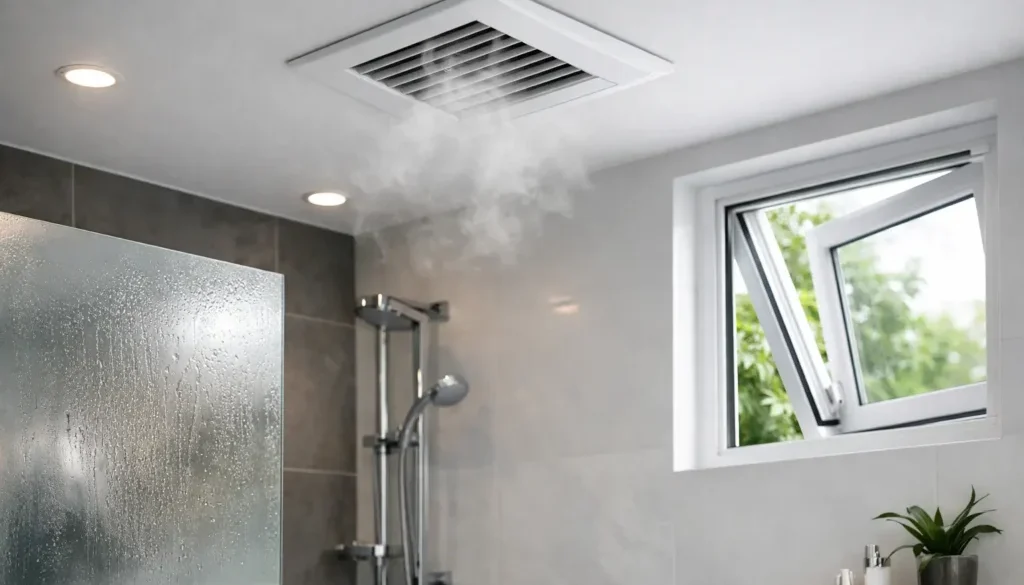
For most homes, the best solution is a correctly sized, externally ducted bathroom exhaust system that is positioned well and continues running after the shower ends. It should remove humid air directly outside, rather than recirculating it into the roof space.
That basic answer has important variations. A small ensuite with an external wall may suit a quality wall-mounted fan. A larger family bathroom, an internal bathroom or a bathroom with a long duct run may need a more powerful ceiling fan or an inline fan located in the roof space. In homes with persistent condensation or broader indoor air quality concerns, a whole-home mechanical ventilation system can work alongside dedicated bathroom extraction.
The right choice depends on the bathroom volume, shower use, window availability, layout, duct length, roof access and the home’s wider moisture pattern. One fan model is not automatically the answer for every bathroom.
Why opening a window is rarely enough
Opening a bathroom window helps when outdoor conditions are dry and there is enough natural airflow. But it is unreliable as the main moisture-control strategy. On a cold, still Melbourne morning, the window may remain shut for comfort, privacy or security. Even when it is open, air may not move efficiently from the shower area to outdoors.
Natural ventilation also cannot be switched on automatically or kept operating once everyone has left the room. Mechanical extraction gives homeowners control. It draws moisture-laden air out when it matters most, helping surfaces dry sooner and reducing the conditions mould needs to grow.
A window and an exhaust fan can work well together, but the fan should do the dependable work.
Start with extraction, not just airflow
Bathroom ventilation has one central job: capture humid air at its source and expel it outside. Air movement in the room may feel pleasant, but it is not enough if the moisture is only being shifted into the hallway, roof cavity or adjacent bedroom.
A fan that vents into the roof space is a common but costly mistake. The moisture has not disappeared. It can condense on roof timbers, insulation and other cold surfaces, creating a hidden dampness problem. Every bathroom exhaust system should be ducted to an appropriate external outlet.
Duct design matters almost as much as fan capacity. Long, narrow, sagging or sharply bent ducting restricts airflow and makes the fan work harder. Poorly insulated ducting can also allow condensation to form within the duct. A professional installation considers the entire air path, not just the grille seen from the bathroom ceiling.
Size the fan for the room and its use
A compact powder room does not need the same extraction as a large bathroom with a shower, bath, double vanity and regular family use. Fan selection should account for room size, ceiling height and how much moisture is being produced.
It also needs to account for resistance in the duct run. A fan’s advertised airflow can be misleading if it is measured in ideal conditions. Once duct length, bends and external grilles are added, actual airflow can be substantially lower. This is why a fan that seems powerful on paper can disappoint after installation.
A larger fan is not always better. Excessive extraction can create draughts, noise and pressure imbalances if the home does not have a sensible path for replacement air. The goal is effective, balanced moisture removal rather than brute force.
Position the grille where steam collects
The best location is usually near the shower or bath, where steam rises and moisture levels are highest. A grille positioned too far away may extract general room air while leaving the wettest zone slow to dry.
Placement should also avoid obvious obstructions and be considered alongside lighting, heating and ceiling structure. In a renovation or new build, ventilation should be planned early, before the ceiling layout limits the options.
The controls that make a real difference
A good fan can still underperform if it is turned off too soon. Steam remains in the air and on surfaces long after the shower stops. The most practical controls are a run-on timer or humidity sensor.
A timer keeps the fan operating for a set period after the light is switched off. It is simple, predictable and often suits households that want a straightforward solution. A humidity sensor responds to moisture levels, so it can start automatically or continue running until humidity reduces. This is particularly useful in busy family bathrooms, rental properties and homes where people may forget to use the fan.
The setting needs to be sensible. If the timer is too short, it will not dry the room effectively. If a humidity sensor is poorly calibrated, it may run unnecessarily or fail to respond when needed. Installation and commissioning are part of getting the result right.
Noise, energy use and comfort are genuine trade-offs
Many homeowners avoid using an existing fan because it is noisy. That is understandable, but silence should not come at the expense of extraction performance. A well-designed system can be both quiet and effective, particularly where an inline fan is installed away from the bathroom and connected with suitable ducting.
Energy-efficient motors reduce running costs, which makes it easier to let the system run for the time required. However, a low-energy fan with inadequate airflow is not an energy-efficient outcome if moisture damage and mould continue. Look at the complete performance: effective extraction, sensible controls, quiet operation and quality ducting.
Bathroom heating can improve comfort and assist surface drying, but it does not replace extraction. Heating without ventilation can increase evaporation and leave more moisture suspended in the indoor air. The best approach is usually warm, comfortable bathing conditions paired with reliable moisture removal.
When a whole-home system is worth considering
A dedicated exhaust fan is usually the first priority for a bathroom. But recurring condensation throughout the house, mould in bedrooms, stale air, allergy concerns or a tightly sealed new build can point to a broader ventilation issue.
Heat recovery ventilation and energy recovery ventilation systems provide controlled fresh-air exchange across the home while recovering some energy from outgoing air. They are especially relevant where homeowners want healthier indoor air without relying on open windows during cold weather, traffic noise or high-pollen periods. In these designs, bathrooms are commonly treated as extract zones, while fresh filtered air is supplied to living areas and bedrooms.
Positive pressure systems can assist some existing homes, but they are not a substitute for dedicated bathroom extraction. Their suitability depends on the building and moisture source. If shower steam is the problem, it still needs a direct route outdoors.
For older homes with damp subfloors, wet timber framing or musty odours, bathroom ventilation may be only one part of the solution. Underfloor ventilation, drainage improvements and a review of external moisture entry may also be needed. Treating one visible symptom while ignoring moisture below the home can lead to ongoing problems.
Signs your current bathroom ventilation is not working
Watch for patterns rather than one-off events. A steamed-up mirror immediately after a hot shower is normal. Water still running down walls 20 minutes later, a persistent damp smell, black spotting on the ceiling, swollen cabinetry or peeling paint are not.
Other warning signs include a fan that takes a long time to clear steam, condensation spreading into nearby rooms, visible mould returning after cleaning, or a bathroom that feels clammy even when not in use. A blocked grille, failing motor or damaged duct may be the issue, but sometimes the original system was never sized or installed correctly.
Maintenance protects performance
Bathroom fans need basic care. Dust can build up on grilles and reduce airflow, while external vents may become blocked by debris or insect screens. Clean the visible grille carefully and have ducting, outlets and fan operation checked if performance drops or noise changes.
If the fan is old, rattling or ineffective, replacing it with another like-for-like unit may not solve the problem. It is worth checking the duct route, outlet location and control method before selecting a replacement.
The most useful next step is to notice what happens after the next shower. If the room remains wet, the mirror stays fogged and the air feels heavy long after the door opens, your bathroom is asking for a ventilation solution designed around the home, not a quick fan swap.