
Condensation on bedroom windows, a lingering musty smell and mould returning to the same corner are rarely just cleaning problems. They are often signs that moist indoor air has nowhere reliable to go. Heat recovery ventilation addresses that problem by continuously replacing stale air with filtered outdoor air, without throwing away all the warmth you have paid to create.
For Melbourne and Victorian homeowners, this can make a meaningful difference through cool winters, closed-up houses and increasingly well-sealed renovations or new builds. The aim is not to make a home feel draughty. It is to give moisture, carbon dioxide, odours and everyday pollutants a controlled path out while bringing fresh air in.
How heat recovery ventilation works
A heat recovery ventilation system, often called an HRV, uses a central unit or individual room units to move air in two directions at once. Stale, humid air is extracted from areas such as bathrooms, laundries and kitchens. At the same time, fresh outdoor air is supplied to living spaces and bedrooms.
Inside the unit is a heat exchanger. The outgoing warm air passes through one side of it and the incoming cooler air through the other. The air streams remain separate, but heat transfers between them. In winter, this means incoming fresh air can be pre-warmed by the stale air leaving the house.
That distinction matters. Opening windows can certainly improve ventilation when weather and security allow, but it also loses heated air and does not provide dependable moisture control overnight, during rain or when the home is empty. An HRV is designed to provide low-level, balanced ventilation every day rather than relying on occasional bursts of fresh air.
The result should be a home that feels fresher and less damp, with less condensation forming on cold glass and other surfaces. It is not an air conditioner and does not create heat. Instead, it reduces the energy penalty usually associated with bringing fresh air indoors.
Why moisture control matters inside a home
Every household creates moisture. Showers, cooking, clothes drying, breathing, pot plants and unvented gas appliances all add water vapour to the air. In a poorly ventilated home, that moisture can settle on the coldest surfaces – windows, external walls, ceilings and inside roof spaces.
When condensation happens repeatedly, mould can establish itself on paint, plaster, furnishings and window reveals. The visible patch is only part of the issue. Persistent humidity can also contribute to musty odours, dust mite activity, damage to finishes and discomfort for people with allergies or asthma.
Heat recovery ventilation does not remove the need for sensible habits. Bathroom exhaust fans should still be used, rangehoods should vent cooking moisture effectively, and indoor clothes drying may need to be managed carefully. What a properly designed system does is deal with the background moisture that builds up between those moments.
This is particularly valuable in homes where residents keep windows closed for warmth, traffic noise, pollen, bushfire smoke concerns or security. It can also help in renovated homes where better insulation and draught sealing have improved thermal performance but reduced accidental airflow.
Heat recovery ventilation is not the same as every HRV product
The term HRV is sometimes used loosely, which can make comparing systems confusing. True balanced heat recovery ventilation extracts stale air and supplies fresh air through dedicated pathways, using a heat exchanger to retain thermal energy.
Positive pressure systems operate differently. They typically introduce filtered roof-space or outdoor air to create slight pressure within the home, encouraging indoor air out through natural gaps. They can suit some properties and may improve air movement, but they do not provide the same balanced extraction and heat recovery as a dedicated HRV system.
Energy recovery ventilation, or ERV, is another related option. Along with heat, an ERV can transfer some moisture between outgoing and incoming air streams. In the right setting this can be useful, but the best choice depends on the home, local climate, occupancy and the moisture problem being solved. A system should not be selected by acronym alone.
Centralised or decentralised: the right layout depends on the house
A centralised system uses a main ventilation unit connected to several rooms by ductwork. It can deliver whole-home ventilation in a discreet, coordinated way and is often easiest to incorporate into a new build, major renovation or home with accessible roof space. Good design is essential, as duct routes, ceiling voids, insulation and access for servicing all affect the final outcome.
Decentralised heat recovery units are installed through external walls and usually serve individual rooms or paired spaces. They can be an excellent option for existing homes where running ducts would be disruptive or impractical. They are often considered for problem bedrooms, living rooms or smaller renovations, although a room-by-room approach needs careful planning to ensure moisture-producing areas are still properly ventilated.
Neither option is automatically better. A compact brick veneer home with repeated window condensation may suit a different solution from a large double-storey renovation, an airtight architectural build or an older weatherboard house with multiple sources of dampness. The source of the moisture, not just the mould location, needs to guide the design.
What to expect from a well-designed system
The quality of installation is as important as the equipment itself. A heat recovery system must be sized for the home and arranged so fresh air reaches the rooms where people spend time, while humid air is extracted where it is produced. Air needs a way to travel between rooms too, often through door undercuts, transfer grilles or carefully planned pathways.
Noise also deserves attention. A system that is technically effective but too loud is less likely to be run as intended. Appropriate unit selection, duct sizing, fan settings and installation details help maintain quiet, background operation.
Filters are another practical benefit. Depending on the unit and filter grade, incoming air can be cleaned of dust, pollen and other particles before it enters the home. Filters do not make outdoor pollution disappear, and they require regular replacement or cleaning. For households affected by allergies, however, filtered mechanical ventilation can be more practical than leaving windows open for long periods.
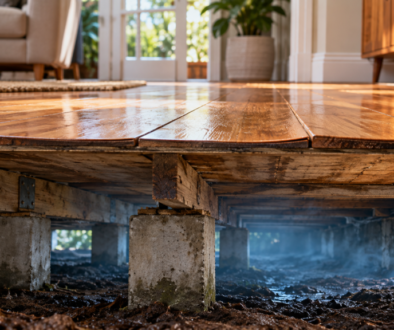
A professional assessment should also look beyond the living areas. If there is moisture under the house, wet subfloor soil, poor drainage, plumbing leaks or inadequate bathroom extraction, these may need separate attention. Heat recovery ventilation improves indoor air exchange, but it cannot fix a building defect or remove water entering through the structure.
Is heat recovery ventilation worth it in Melbourne?
For many Victorian homes, the answer is yes when there is a clear need for controlled fresh air, condensation reduction and greater winter comfort. It is especially worth considering during a renovation or new build, when ducting and power can be planned early. Existing homes can benefit too, particularly through decentralised solutions or carefully designed retrofit systems.
The trade-off is upfront cost and the need for ongoing maintenance. Heat recovery systems are more involved than fitting a basic exhaust fan, and the wrong design can leave rooms under-ventilated or make installation needlessly intrusive. Homeowners should also have realistic expectations: a system can greatly reduce condensation risk, but cold bridges, water leaks and very high moisture loads may still require additional work.
The strongest results come from treating ventilation as part of the home rather than an add-on product. At Ecoflow Ventilation, that means assessing how your home is built, where moisture is generated, how rooms are used and what access is available before recommending a system.
If your windows are sweating each winter or your home never quite loses its damp smell, start by identifying where the moisture is coming from and where the air is getting stuck. A tailored ventilation plan can turn that recurring problem into a healthier, drier and more comfortable way to live.