A damp, musty smell that returns after rain is rarely just a housekeeping issue. It often points to moisture collecting beneath the floor, where timber, insulation and floor framing can remain cool and poorly ventilated for long periods. This subfloor ventilation fan review explains what separates a useful system from a fan that simply moves a little air without addressing the real cause of dampness.
For Melbourne and Victorian homes, the best choice is seldom the largest fan or the cheapest kit. Subfloors vary greatly in size, clearance, soil moisture, vent locations, drainage, insulation and access. A worthwhile assessment considers the whole underfloor environment before recommending equipment.
What a subfloor ventilation fan is designed to do
A subfloor ventilation fan replaces stale, humid air beneath the house with drier outside air when conditions allow. By improving air movement through the cavity, it can help reduce the persistent moisture that contributes to musty odours, mould growth, timber movement and deterioration of floor structures.
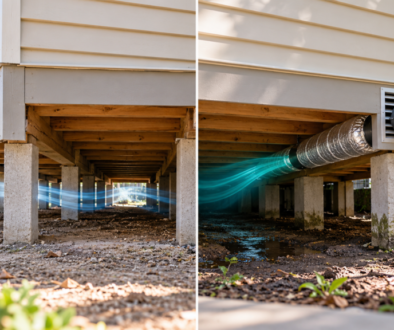
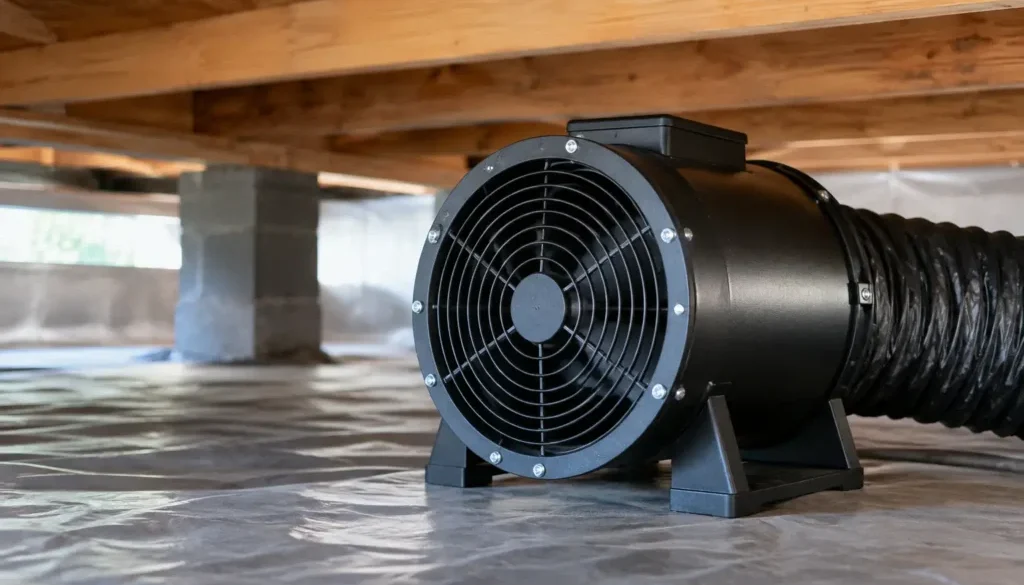
Most residential systems use one or more inline or wall-mounted fans connected to ducts and purpose-positioned vents. Depending on the design, the fan may extract damp air from one part of the subfloor, draw fresh air in from another, or create a planned pathway across the entire space.
The key word is planned. A fan fitted to a single existing vent may make noise and use electricity, yet have little effect if air cannot travel through the rest of the subfloor. Good ventilation depends on intake points, exhaust points, barriers such as internal brickwork, and the source of the moisture itself.
Subfloor ventilation fan review: the features that matter
Airflow matched to the space
Airflow is commonly advertised as a large number, but more airflow is not automatically better. An oversized system may be noisier, use more power and pull outdoor air through the cavity too aggressively without improving the underlying moisture problem. An undersized system may run continuously with little measurable change.
The appropriate airflow depends on the subfloor volume and layout. A low, enclosed area with many separate compartments usually needs a different approach from an open subfloor with good cross-ventilation but one persistently wet corner. Duct length, bends and grilles also reduce real-world airflow, so a fan’s laboratory rating should not be treated as its performance once installed.
Controls that respond to moisture conditions
Basic timer controls can be effective where moisture patterns are predictable. For example, a system may be set to run during the parts of the day when outdoor air is generally more suitable for drying the subfloor.
Humidity-aware controls offer a more refined option. They can reduce unnecessary running and help avoid bringing in humid outdoor air when it is unlikely to assist drying. This is particularly relevant in Melbourne, where cool, wet weather and humid summer days can make a fixed run schedule less efficient.
However, controls are not a substitute for sound design. A sophisticated controller on a poorly placed fan will not solve blocked vents, wet soil or a plumbing leak.
Noise and vibration control
Subfloor fans should be noticeable only by their results, not by a constant hum through the floorboards. Noise depends on fan quality, speed, mounting method, duct design and whether vibration has been isolated from the building structure.
For bedrooms, living areas and homes with lightweight timber floors, quiet operation deserves proper attention. A lower-speed, correctly sized fan system is often a better long-term choice than a high-speed unit forced to work around poor airflow pathways.
Energy use and durability
Energy-efficient motors matter because subfloor systems may need to operate regularly across changing seasons. Look beyond the purchase price to the expected running hours, motor efficiency and the practicality of servicing the equipment.
The underfloor environment can be dusty, damp and difficult to access. Components should be suited to that setting, with protected electrical connections, securely fixed ducting and grilles that keep out leaves, pests and wind-driven rain. A system that cannot be accessed for inspection is harder to maintain and troubleshoot.
The installation is as important as the fan
A fan is only one component of subfloor moisture control. Before installation, the space should be inspected for signs of standing water, leaking pipes, poor site drainage, damaged downpipes, blocked external vents and inadequate ground moisture protection.
If water is entering the subfloor after rainfall, ventilation may help dry residual dampness but cannot stop the water source. Similarly, a ground vapour barrier can be highly beneficial where moisture is rising from exposed soil, yet it needs to be selected and installed appropriately. Sealing off all vents without a designed mechanical solution can make a damp subfloor worse.
A practical design also considers where the discharged air goes. Exhaust air should not be directed into a roof space, wall cavity or other enclosed area where moisture could create a new problem. It should be discharged safely outdoors, away from openings where it may be drawn back into the home.
When more than one fan is needed
One fan can be enough for a compact, open subfloor with a clear path for replacement air. Larger homes, L-shaped footprints and properties with internal foundation walls may need multiple fans or ducted branches to prevent stagnant zones.
Older homes often reveal the limitations of a simple off-the-shelf kit. Additions, enclosed verandahs, garden beds built against vents and partial renovations can all alter how air travels below the floor. In these cases, a tailored layout is more valuable than a one-size-fits-all package.
What a fan can and cannot fix
A correctly designed subfloor system can make a meaningful difference to musty smells, moisture levels and the comfort of timber floors. It may also support the protection of joists, bearers and flooring by reducing prolonged damp conditions.
It cannot repair rot, fix a leaking shower drain, remove floodwater or compensate for poor external drainage. It also will not necessarily solve condensation on windows or mould on internal walls. Those symptoms can be caused by indoor humidity, insufficient whole-home ventilation, cold surfaces or bathroom and kitchen moisture. They need to be assessed as part of the broader moisture picture.
This distinction matters because homeowners sometimes install a subfloor fan hoping it will cure every damp-related issue in the house. If moisture is travelling upward from the subfloor, the system may be part of the answer. If the issue is moisture generated inside the living areas, a different ventilation strategy may be required.
Questions worth asking before you buy
Before choosing a system, ask whether the installer has measured or assessed the subfloor area, identified existing vents and checked for standing water or drainage defects. Ask how the proposed fan capacity was selected, where replacement air will enter, and how noise and vibration will be managed.
It is also reasonable to ask about electrical compliance, weather protection, service access and expected running costs. A clear answer should explain the design in plain language rather than relying only on a fan specification sheet.
For homes with recurring mould, wet soil, cold floors or a strong under-house odour, an inspection can prevent money being spent on the wrong solution. Ecoflow Ventilation approaches subfloor ventilation as part of a home-specific moisture and air-quality strategy, not as a product selected from a shelf.
A better way to judge value
The best subfloor ventilation fan is the one that creates useful, controlled airflow through your actual underfloor space while operating quietly and efficiently. Product quality is important, but layout, moisture diagnosis and installation standard determine whether that quality translates into a drier home.
If the smell under your house is becoming part of daily life, treat it as useful information. Finding where the moisture starts is the most reliable first step towards a healthier, more comfortable home above it.