A laundry can release several litres of moisture into your home over the course of a wash and dry cycle. When that humid air has nowhere effective to go, it settles on cooler surfaces, feeds mould growth and can leave the room smelling damp long after the clothes are folded. Improving laundry room ventilation is therefore about more than clearing steam. It is a practical way to protect indoor air quality, finishes and the comfort of the rooms around it.
For many Melbourne homes, the problem becomes most obvious through winter. Windows sweat, walls feel cold, towels take longer to dry and a musty smell may drift from the laundry into the hall or kitchen. Cleaning visible mould can help temporarily, but it will not fix the moisture source or the lack of air movement behind the problem.
Why laundry moisture needs a way out
Every washing load leaves water in fabrics. If clothes are dried indoors, on a rack or in a dryer that is not properly ducted outside, that moisture enters the room air. A washing machine, laundry sink and wet shoes or sports gear can add to the load as well.
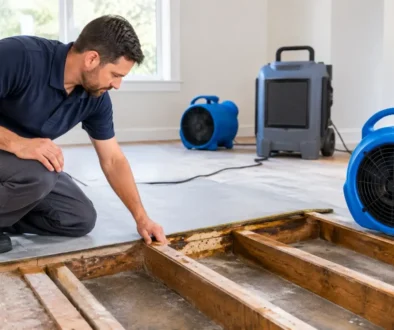
Warm, humid air naturally moves towards cooler areas of the house. It can then condense on window glass, external walls, ceilings and inside cupboards. Over time, repeated moisture exposure may contribute to peeling paint, swollen cabinetry, mildew on fabrics and mould around skirting boards. In homes with existing condensation issues, an enclosed laundry can make the whole-house problem worse.
A small window is not always an adequate solution. It may be impractical to leave open during rain, cold weather or when nobody is home. Some laundries are internal rooms with no external window at all. Even where a window is available, natural ventilation depends on wind direction, temperature and how well air can travel through the space.
Improving laundry room ventilation starts with the moisture source
The most effective approach is to deal with moisture where it is created, then make sure replacement air can move through the home in a controlled way. This is more reliable than simply hoping humidity will disperse on its own.
Check the dryer arrangement first
A vented clothes dryer should generally discharge outdoors through suitable ducting, not into the laundry, roof space, wall cavity or garage. Releasing warm, wet dryer air into an enclosed area can rapidly raise humidity and create condensation in places that are difficult to see or clean.
Duct runs should be as short and straight as practical, with correctly sized, well-sealed ductwork. Long flexible ducting with multiple bends restricts airflow, collects lint and reduces the dryer’s performance. The exterior outlet also needs to be positioned so moist air is not drawn back through a nearby window, door or ventilation intake.
Condenser and heat-pump dryers do not need the same external exhaust duct, but they still produce heat and can add some moisture to the room, especially if the water tank is not emptied or the drain connection is poorly maintained. They are often a more energy-efficient option, but they do not remove the need for general laundry ventilation.
If you have a gas dryer, appliance safety and combustion ventilation require particular care. Seek advice from a qualified professional before changing its ducting, location or surrounding ventilation.
Use extraction that actually reaches outside
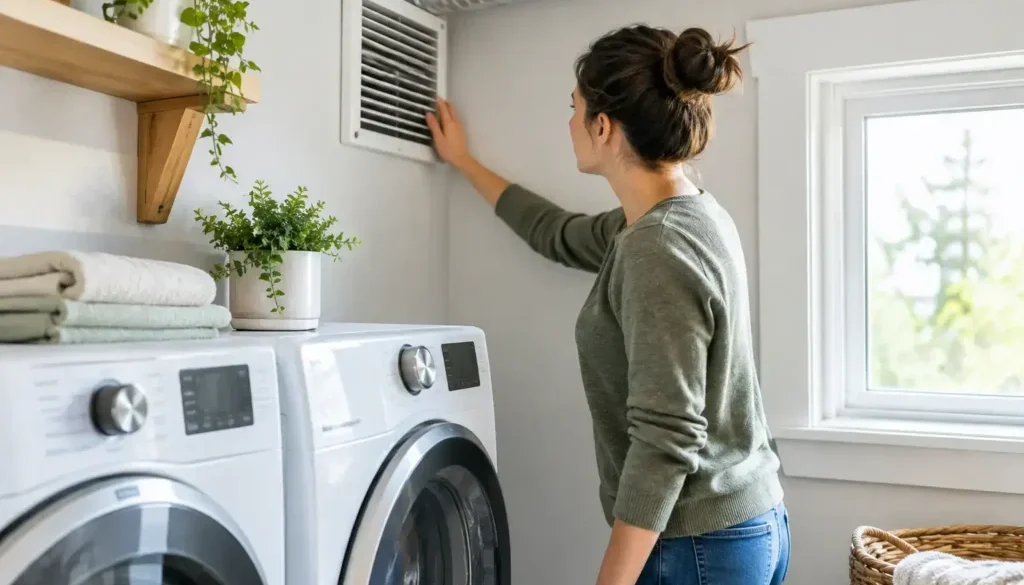
For an internal laundry, a properly selected mechanical exhaust fan is usually the foundation of moisture control. It should remove humid air directly to the outdoors, rather than terminating in the ceiling space. A fan that is noisy, undersized or poorly ducted may be switched off quickly, which defeats its purpose.
Fan capacity depends on the room volume, whether clothes are dried inside, the duct length and the amount of moisture generated. It is also worth considering how the fan is controlled. A run-on timer or humidity sensor can keep extraction operating after the washing is finished, when moisture remains suspended in the air. This can be especially useful for busy households where the laundry is used throughout the day.
Extraction works best when there is a path for fresh air to enter the room. A door undercut, transfer grille or planned make-up air route may be needed. Without it, the fan can struggle against a tightly sealed room and deliver far less airflow than expected.
When a single fan is not enough
A laundry is often part of a wider moisture pattern. If you are also seeing condensation on bedroom windows, mould in wardrobes, stale air in living areas or dampness under the house, replacing the laundry fan alone may only address one part of the issue.
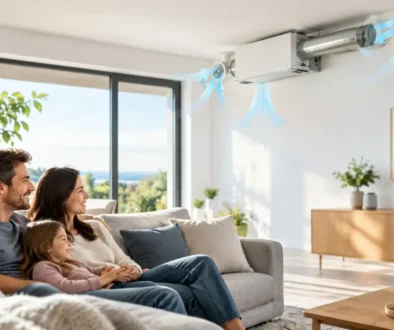
Whole-home mechanical ventilation can provide steadier air exchange across multiple rooms. Depending on the building and the household’s needs, this may involve a centralised system, decentralised units, positive pressure ventilation or an energy recovery ventilation system. The right option depends on the home’s layout, airtightness, insulation, moisture sources and how occupants use the space.
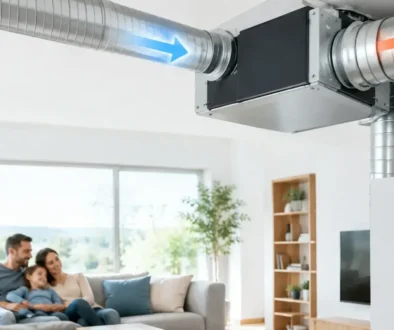
Heat recovery and energy recovery ventilation systems can be particularly valuable in homes where owners want fresh-air ventilation without throwing away as much heating or cooling energy. These systems exchange stale indoor air for filtered outdoor air while recovering heat, and some configurations can help manage moisture transfer as well. They are not a substitute for local extraction from a laundry or bathroom, but they can support healthier air throughout the home.
Positive pressure systems may assist with general air movement in some homes, yet they must be designed carefully. Pressurising a house without understanding where moisture is being generated and how it will be exhausted can shift humid air into wall or roof cavities. A home-specific assessment avoids treating ventilation as a one-size-fits-all product.
Practical habits that support better airflow
Mechanical ventilation does the heavy lifting, but day-to-day habits still matter. Avoid drying multiple loads of washing on racks in a closed laundry where possible. If indoor drying is necessary, use the extraction fan and keep the laundry door arranged to allow make-up air into the room.
After washing, check for standing water behind appliances, under the laundry trough and around hose connections. Even a slow leak can keep a compact room humid and create a persistent damp smell. Clean the dryer lint filter after every cycle, and inspect external vents and ducting periodically for lint build-up or damage.
Keep cabinetry and storage away from obvious damp patches, and do not pack wet mops, bath mats or towels into a closed cupboard. These simple measures will not correct an undersized ventilation system, but they reduce the moisture burden it has to manage.
Signs your laundry needs professional attention
Some warning signs are easy to dismiss because they come and go with the seasons. They are still worth investigating, particularly when moisture keeps returning after cleaning. Look for the following patterns:
- Condensation on laundry windows, walls or ceilings during washing and drying.
- A musty odour that returns soon after the room has been aired out.
- Mould around window frames, behind appliances, inside cupboards or on ceilings.
- Paint bubbling, plaster staining or cabinetry swelling near wet areas.
- Clothes taking an unusually long time to dry, despite using a dryer or exhaust fan.
- An exhaust fan that is loud, weak, dripping or venting into the roof space.
A ventilation assessment can identify whether the main issue is local extraction, dryer ducting, inadequate make-up air, broader household humidity or a combination of these factors. This is particularly useful in renovated homes, where new insulation and sealed windows may improve energy efficiency but also reduce incidental airflow.
Choose a solution that suits the home, not just the room
The best laundry ventilation solution balances moisture removal, noise, energy use and the way your household lives. A compact internal laundry may benefit most from quiet, timed extraction and properly managed dryer exhaust. A larger home with repeated condensation and mould may need that local solution integrated into a wider ventilation plan.
For homeowners across Melbourne and Victoria, Ecoflow Ventilation takes this home-specific approach because the same symptom can have very different causes. Addressing the laundry’s moisture at the source, while considering airflow through the rest of the house, gives you a better chance of keeping the room dry without relying on open windows or constant cleaning.
A laundry should be a hardworking room, not a hidden source of damp air. When ventilation is designed around the room, the appliances and the home as a whole, every load of washing becomes a little easier on your indoor air and your property.