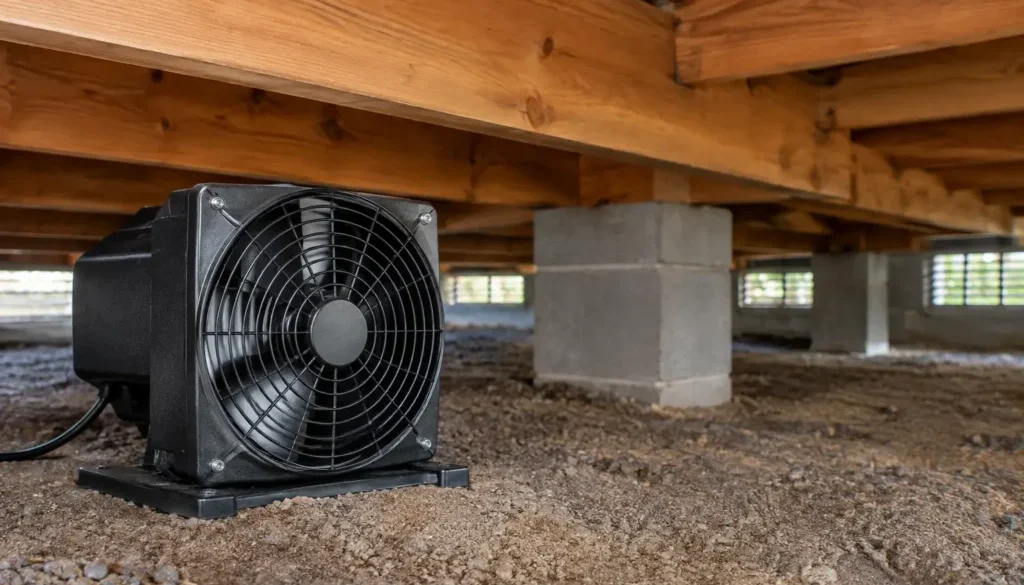
A musty smell under the house, cold timber floors or recurring mould can leave homeowners asking one practical question: when should subfloor fans run? The short answer is that most professionally designed subfloor ventilation systems should run continuously, or for long daily periods, rather than only when the problem becomes noticeable. But the best schedule depends on what is making the subfloor damp in the first place.
Fans can improve air movement and help moisture leave a confined underfloor area. They cannot, however, compensate for a plumbing leak, poor site drainage or groundwater entering through the foundations. Getting the timing right matters, but so does identifying the source of moisture.
When should subfloor fans run?
For many Melbourne homes, continuous operation is the most reliable approach. Modern subfloor fans are generally designed for low-energy, ongoing use. Keeping air moving consistently prevents moisture from lingering beneath the floor, where it can be absorbed by timber framing, flooring and insulation.
Running fans only for an hour or two after noticing a damp smell is rarely enough. By that point, moisture may have been accumulating quietly for weeks or months. Regular airflow is more effective because it supports a drier, more stable subfloor environment over time.
That said, there is no universal timer setting for every property. A home on a sloping block in Eltham, for example, may face different moisture pressures from a weatherboard home near the bay or a house with a low-clearance crawl space in Melbourne’s eastern suburbs. Fan run times should be based on the subfloor layout, available vents, fan capacity, moisture source and the home’s local conditions.
Why continuous airflow often makes sense
The underfloor area is usually cooler, darker and less accessible than the rest of the home. If it has limited natural ventilation, moisture from the ground, rainwater runoff, humid outdoor air, small plumbing leaks or everyday evaporation can become trapped. This creates the familiar earthy smell many homeowners notice through floor gaps, cupboards or wall cavities.
Continuous mechanical ventilation helps replace moisture-laden air with fresh air and reduces stagnant pockets where mould can develop. It may also help protect timber bearers and joists from prolonged dampness, reducing the risk of fungal decay, floor movement and a soft or bouncy feel underfoot.
For households affected by allergies, asthma or mould sensitivity, reducing the damp reservoir below the home can also support healthier indoor air. Air from the subfloor can migrate upwards through penetrations around pipes, services and flooring, particularly when the house is closed up during cooler weather.
Are timers a good option for subfloor fans?
Timers can be useful, particularly where a system has been designed around known site conditions. A timer may run fans overnight, during selected daytime hours or for extended blocks each day. This can reduce operating costs while still delivering meaningful ventilation.
The trade-off is that a timer only works well when the schedule matches the problem. A short run time may not provide enough air changes in a very damp, enclosed subfloor. Conversely, a simple timer may continue operating when outdoor conditions are unsuitable for drying the space.
In some situations, humidity-responsive controls are a better fit. These controls can be set to respond when moisture levels rise, although they need to be selected and commissioned carefully. Relative humidity alone does not always tell the full story. Cool air can show high relative humidity while holding little actual moisture, and bringing humid outdoor air into a cooler subfloor can sometimes make conditions worse.
A considered design looks at the whole moisture picture rather than relying on a generic timer setting.
The role of outdoor weather
Melbourne’s weather can shift quickly, and wet winter periods can put extra pressure on older homes with damp subfloors. During prolonged rain, fans may still be part of the solution, but they should not be treated as a substitute for drainage and waterproofing work.
If rainwater is flowing towards the house, overflowing from gutters, collecting beside footings or entering through inadequate drainage, the first priority is to stop that water at its source. Likewise, a leaking pipe beneath the home needs repair before ventilation can do its job properly.
Once bulk water entry is controlled, consistent airflow can help the area dry and remain drier. In particularly damp homes, it may be appropriate to run fans continuously through winter and reassess performance as conditions change.
Signs your fans may not be running enough
A functioning fan is not always an effective ventilation system. If the fans run but the subfloor remains damp, the issue may be fan run time, system design, blocked vents or an untreated water source.
Warning signs include a persistent musty odour indoors, visible mould on subfloor timbers, condensation on ducting or pipes, rusting metalwork, wet soil, cupping timber floorboards, or recurring mould on internal walls. Cold floors can also be a clue, although insulation gaps and draughts may be contributing factors.
It is worth checking that external grilles are clear of leaves, soil, garden beds and stored items. A fan cannot move its rated airflow if intake or exhaust points are obstructed. Ductwork should also be correctly sized and routed, with airflow distributed across the subfloor rather than concentrated in one easily ventilated corner.
Why fan direction and placement matter
Subfloor ventilation is more than installing a fan in an existing vent. Effective systems create a planned path for air to travel through the entire underfloor space. Depending on the home, fans may extract damp air from one side while replacement air enters through suitable openings elsewhere. Other designs may introduce fresh air in a controlled way.
The aim is to avoid short-circuiting, where a fan draws air from the nearest opening and leaves remote areas stagnant. Homes with internal brick walls, additions, low-clearance sections or irregular foundations often need closer assessment because air cannot always move freely beneath the floor.
Poor placement can lead to disappointing results and unnecessary power use. Correct fan selection, ducting and grille locations are just as important as the operating schedule.
Can subfloor fans run all year?
Yes, many systems can run all year, and for damp-prone homes this is often preferable. Moisture problems are not limited to winter. Summer storms, humid days, shaded ground, irrigation overspray and moisture rising from the soil can all affect the subfloor.
A year-round approach is particularly sensible where there is a history of damp odours, mould or timber moisture concerns. In a dry, well-ventilated subfloor, a professional may recommend a reduced schedule at certain times of year. The decision should be based on evidence, not simply on the season.
Monitoring can be helpful. Moisture readings in timber, visual inspections after rain and humidity trends can show whether the system is maintaining stable conditions. If the space remains wet despite long fan run times, further investigation is needed rather than simply adding more hours of operation.
When ventilation is not the first fix
Subfloor fans are highly effective for managing airborne moisture and stagnant air. They are not designed to remove standing water or fix building defects. Before relying on ventilation alone, rule out burst or leaking pipes, poor stormwater management, damaged downpipes, inadequate ground drainage, missing vapour barriers and rising damp concerns.
In some homes, the right answer is a combination of drainage improvements, a ground moisture barrier and tailored mechanical ventilation. This approach addresses both the source of moisture and the conditions that allow it to linger.
For homeowners unsure how long their subfloor fans should run, a site-specific assessment is far more useful than a generic timer recommendation. The best outcome is a system that quietly maintains a drier underfloor, protects the structure and helps the living spaces above feel fresher and healthier every day.